

Insights / Performance marketing
Incremental attribution on Meta: which ROAS really counts
Sascha Blum · · 9 min read
The same Meta account can show three different ROAS figures, depending on how conversions are counted. Standard attribution counts every purchase within a window after a click or view, even if it would have happened without the ad. Incremental attribution counts only purchases that, according to Meta's model, were caused by the ad. The "First conversion" setting additionally counts only the first purchase per person. If you are not aware of these differences, you end up steering your budget by the friendliest number in the account.
Key points
- ROAS is the metric. The attribution model and the conversion count decide which revenue goes into that metric in the first place.
- Standard attribution counts purchases up to 7 days after a link click, 1 day after an engagement and 1 day after a view, regardless of whether the ad caused the purchase.
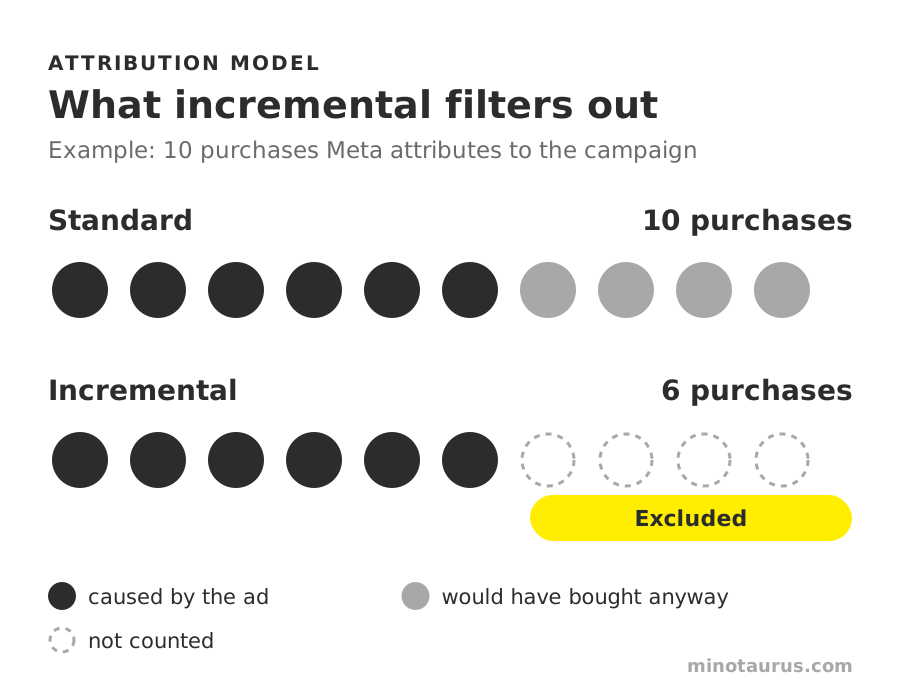
- According to Meta, incremental attribution uses machine learning models that predict whether a conversion was caused by an ad. Purchases that would have happened anyway drop out.
- "First conversion" counts only the first purchase after contact with the ad, "All conversions" also counts repeat purchases by the same person.
- A standard ROAS above your break-even can sit below it incrementally. The campaign then makes money on paper and in reality costs money.
Three terms that are constantly confused
In Ads Manager, "ROAS", "attribution model" and "conversion count" sit side by side as if they were three settings of equal rank. They are not.
| Term | What it is | Question it answers |
|---|---|---|
| ROAS | Metric: attributed revenue divided by ad spend | How much revenue comes back per euro spent on advertising? |
| Attribution model | Rule for which purchases are attributed to an ad: standard or incremental | Which purchases does the ad get credit for? |
| Conversion count | Rule for how many purchases per person count: first or all | Does the same person's second purchase count too? |
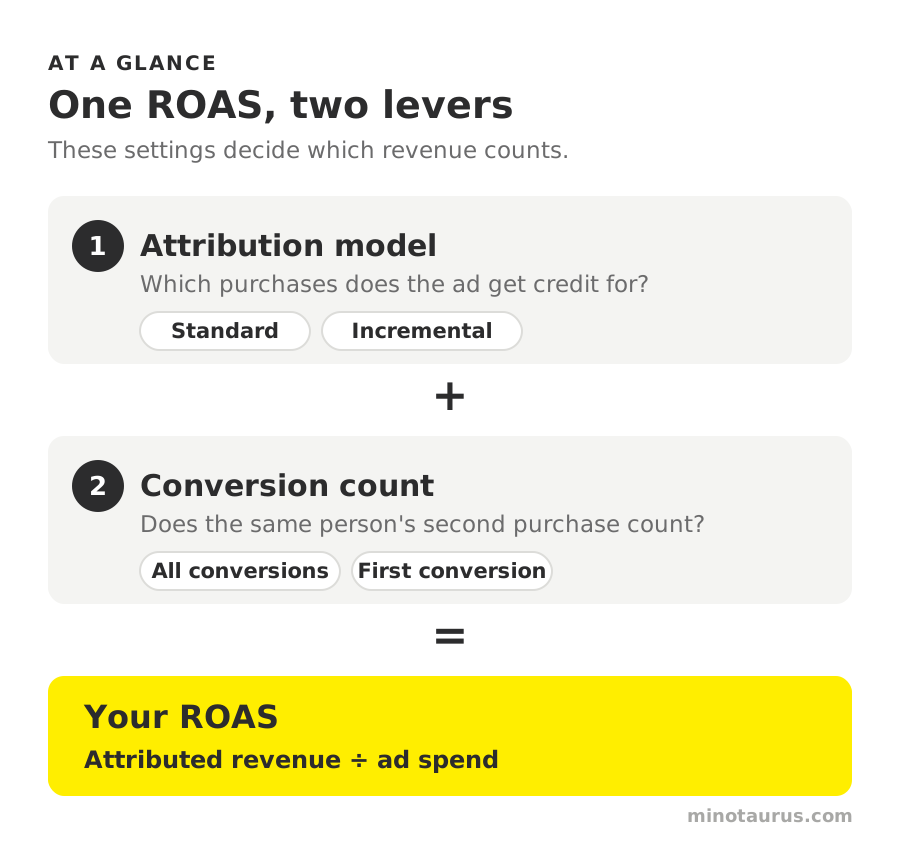
ROAS is therefore always the result of the other two settings. A ROAS quoted without its model and count is as meaningful as a price without a currency.
Standard attribution: what Meta has counted since March 2026
With standard attribution, you define after which type of contact and within which period a purchase is attributed to the ad. Meta changed these rules in March 2026. According to Meta's help page on attribution models and settings, the following applies to website and in-store conversions:
| Setting | What counts | Window |
|---|---|---|
| Click-through | Purchases after a click on a link in the ad | 1 or 7 days |
| Engage-through | Purchases after an engagement without a link click, such as a like, comment, save or share, or for videos after 5 seconds of playback | 1 day |
| View-through | Purchases after the ad was merely viewed | 1 day |
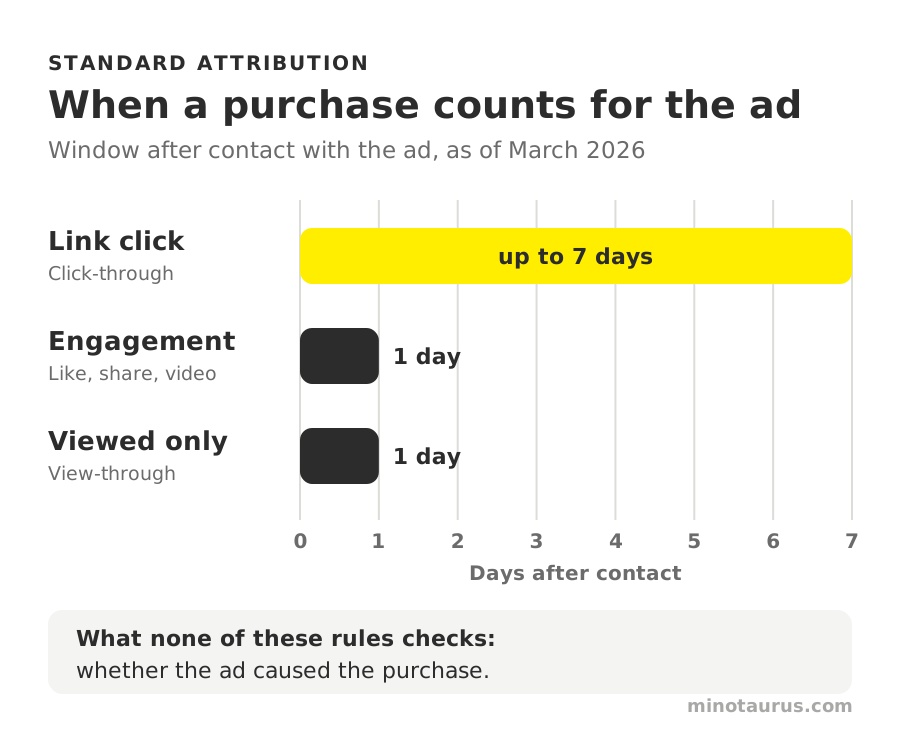
Until the change, every click on an ad counted as click-through, including a like or a click on the profile. These interactions now fall under engage-through. Meta is rolling this out gradually, so individual accounts may still use the old logic.
What matters is what standard attribution does not check: whether the ad influenced the purchase. A regular customer who orders every month anyway and happened to see an ad in her feed the day before counts as a view-through conversion. The revenue lands in the campaign's ROAS.
Incremental attribution: what Meta measures with it
Incremental attribution is an attribution model in its own right. In its help page on incremental attribution, Meta describes it as a model that uses machine learning models to predict whether a conversion was caused by an ad. It works in two directions:
- Optimisation: Meta prioritises delivering the ads to people for whom the ad is likely to make a difference, rather than to people who would buy anyway.
- Reporting: Only conversions that Meta classifies as incremental are counted.
Meta explains the calculation in its help page on results with an example: if a campaign has 100 conversions and 70 of them are considered incremental, the incremental column shows 70 and the standard column 100. Derived metrics such as cost per result and ROAS change accordingly.
Requirements and restrictions
According to Meta's set-up guide:
- Campaign objective Sales, Leads or Engagement
- Conversion location website, or website and app
- Performance goal "Maximise number of conversions" or "Maximise value of conversions"
- No bid controls, so no cost cap and no ROAS goal
- The attribution model cannot be changed after publishing. To switch, you need a new campaign.
You can also view the incremental figures for campaigns running with standard attribution, but only for periods from 1 April 2025 onwards.
First conversion or all conversions
The conversion count is the second lever. Meta defines it in its help page on conversion counting:
- All conversions: Every purchase after contact with the ad within the window counts. If someone buys on Monday and again on Thursday, both purchases and both amounts of revenue count. This is the default setting.
- First conversion: Only the first purchase after contact with the ad counts. The repeat purchase and its revenue drop out.
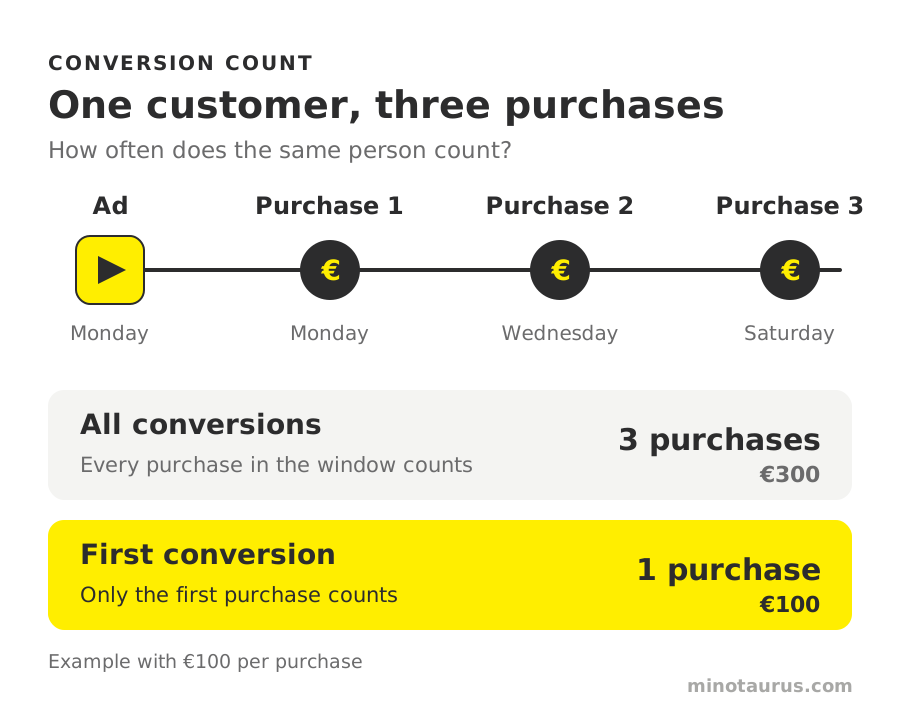
For reporting, you can compare both variants at any time. For optimisation, according to Meta, "First conversion" is only possible with the Sales campaign objective, website as the conversion location, standard attribution and the performance goal "Maximise number of conversions". Incremental optimisation and optimisation for the first conversion therefore cannot be combined.
Meta recommends "All conversions" if every purchase is worth the same to you, and "First conversion" if, for example, you are after leads, where a second enquiry from the same person adds no value.
Worked example: one account, three ROAS figures
Suppose a campaign costs €250 and Meta attributes 10 purchases of €100 each to it under standard attribution. In this example, three groups lie behind these 10 purchases:
- 4 first purchases that the ad caused
- 2 repeat purchases by the same people, also caused by the ad
- 4 purchases by people who would have bought without the ad as well
| View | Purchases counted | Revenue | ROAS |
|---|---|---|---|
| Standard, all conversions | 10 | €1,000 | 4.0 |
| Incremental, all conversions | 6 | €600 | 2.4 |
| Incremental, first conversion | 4 | €400 | 1.6 |
The figures are a simplified example for illustration. In practice, Meta works with probabilities, not individual cases.
The real aha moment: break-even
Assume your shop works with a contribution margin ratio of 40%. Your break-even ROAS is then 1 / 0.4 = 2.5. How to calculate this figure for your product range is covered in our article ROAS or contribution margin?.
- Under standard attribution, the campaign is clearly in profit with a ROAS of 4.0.
- Under incremental attribution, it is just below break-even with a ROAS of 2.4.
- Measured by genuine new customers, it is clearly loss-making with a ROAS of 1.6.
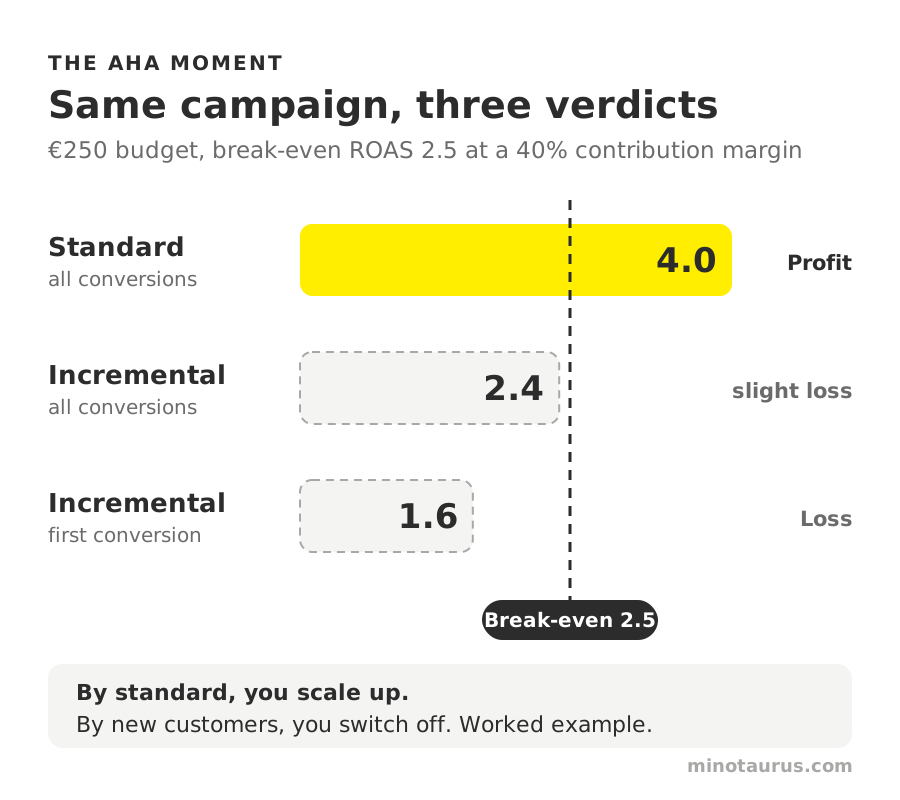
Same campaign, same spend, three decisions: scale up, hold or switch off. If you only look at the standard column, you may well increase the budget of a campaign that mainly reaches regular customers who would have bought anyway.
Why standard and incremental diverge
The gap between the two models shows how many of your attributed purchases would have happened anyway. It typically becomes large with:
- Retargeting: People who have already been in the basket often buy without any further ad.
- Existing customers and brand fans: They see many ads and buy regularly, regardless.
- Campaigns heavy on view-through: A view in the feed is enough for a standard attribution, but proves no effect.
The agency Seer Interactive examined this in April 2025 across around US$1.05 million in ad spend from several accounts. According to Seer Interactive, Meta classified an average of 87% of conversions as incremental, while an analysis in GA4 came to only 67%. Broad audiences and retargeting performed weakest.
And if incremental is higher?
Meta describes the incremental results as a subset of all conversions. If you nevertheless see more incremental than standard conversions in individual ad sets, this is down to the modelling: Meta discloses neither the calculation nor the time frame of the model. Treat such deviations as a signal, not as proof that a campaign is better than expected.
How to compare the figures in Ads Manager
You do not need to launch a new campaign to see the differences in your account:
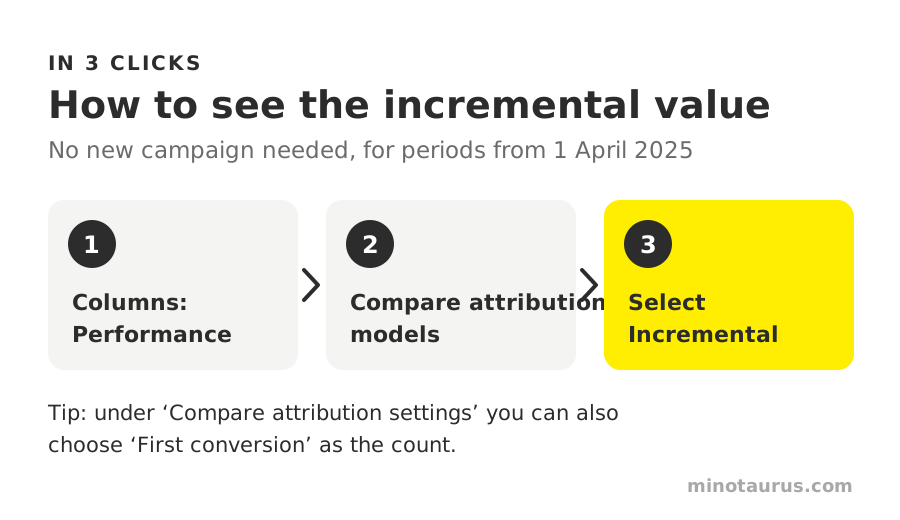
- Compare attribution models: In Ads Manager, open the "Columns: Performance" menu, choose "Compare attribution models" and then "Incremental". Meta describes this in its help page on results.
- Compare attribution settings: In the same menu you will find "Compare attribution settings". There you can set 1-day view, 1-day click, 7-day click and 28-day click side by side and choose "All" or "First" as the conversion count. According to Meta's help page on comparing settings, this works regardless of what the campaign is optimising for.
- Compare like with like: Meta explicitly points out that results from ad sets with different attribution models are not comparable in the campaign overview. Compare campaigns within the same model.
Which setting for which purpose
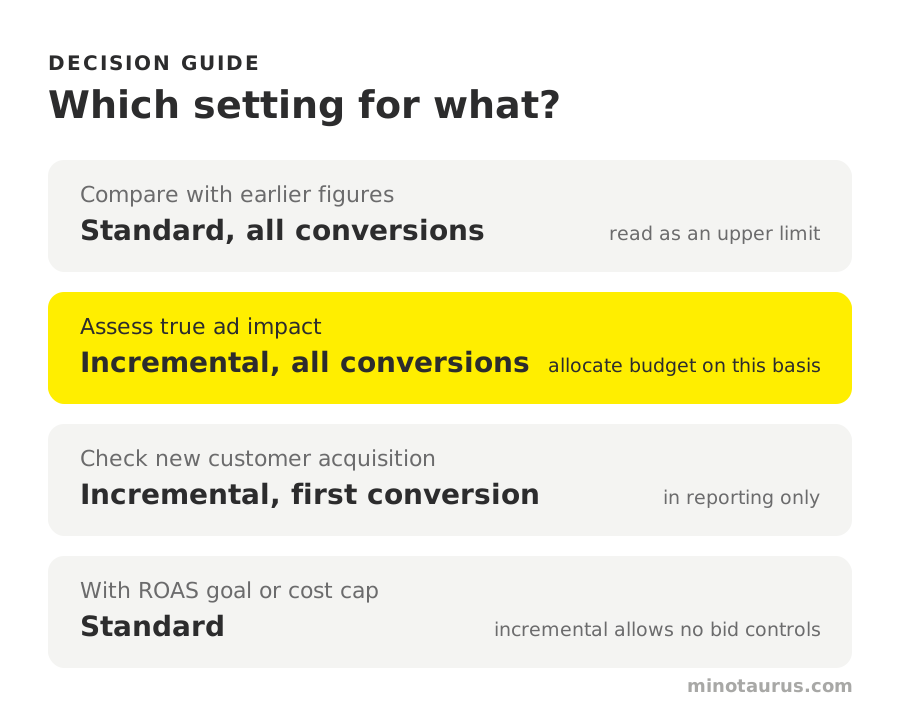
| Goal | Recommendation |
|---|---|
| Comparison with earlier periods and reports | Standard, all conversions, read as an upper limit |
| Assess true ad impact, allocate budget | Incremental, all conversions |
| Assess new customer acquisition | Incremental, first conversion in reporting |
| Leads without duplicate enquiries | Standard with optimisation for first conversion |
| Campaign with cost cap or ROAS goal | Standard, because incremental allows no bid controls |
If your account has enough conversions to exit the learning phase reliably, a test with incremental optimisation in a new campaign is worthwhile. With very few conversions per week, standard often remains the more stable choice.
Where incremental attribution reaches its limits
Incremental attribution is a model from Meta that Meta itself evaluates. That does not mean it is wrong, but it does not replace independent measurement. According to PPC Land, Meta itself calls conversion lift studies, in which a control group sees no ads, the "gold standard" of measurement.
So check the figures against other sources:
- Shop back end: How many new customers and orders does your shop actually record?
- Holdout or lift tests: What happens when a region or audience sees no ads for a few weeks?
- Clean data: If purchases are missing in the pixel, even the best model calculates with gaps. How to fix this is covered in the article Server-side tracking.
Checklist for your Meta account
- Show the "Incremental" column: Compare standard and incremental conversions per campaign for the last 30 days.
- Check the gap by campaign type: Look at retargeting, prospecting and brand campaigns separately.
- Add first conversion: If the figure differs strongly from "All conversions", a large share of your attributed revenue is repeat purchases.
- Put the break-even ROAS alongside: If a campaign is above break-even only under standard but not incrementally, it needs reviewing.
- Standardise reporting: Decide which model applies in the monthly report, and compare campaigns only within the same model.
- Test incremental optimisation: In a new campaign, without bid controls, with enough budget for the learning phase.
Frequently asked questions
Is the incremental ROAS always lower than the standard ROAS?
Meta describes the incremental results as a subset of all conversions. As a rule, the incremental ROAS is therefore lower. Upward deviations in individual ad sets are model effects and should not be counted as success.
Can I switch a running campaign to incremental attribution?
No. According to Meta, the attribution model cannot be changed after publishing. To switch, you set up a new campaign. You can, however, view the incremental figures for existing campaigns at any time via "Compare attribution models".
Can I optimise incrementally and count only first conversions at the same time?
Not for optimisation. According to Meta, optimising for the first conversion requires standard attribution. In reporting, you can analyse both views side by side.
Does incremental attribution work with a ROAS goal or cost cap?
No. Meta does not allow bid controls with incremental attribution.
From when is incremental data available?
According to Meta, the comparison column shows no results for periods before 1 April 2025.
Which ROAS belongs in the monthly report?
The one you use consistently. We recommend using incremental as the steering metric and showing standard alongside it as the upper limit. What matters is that targets, break-even and comparisons are always calculated in the same model.
Conclusion
The ROAS in Ads Manager is not a fixed figure but the result of two settings that many advertisers have never consciously chosen. Standard attribution shows what happened after an ad. Incremental attribution estimates what happened because of an ad. First conversion shows how much of that is new business. If you steer budgets by contribution margin, you should know all three views and base decisions on the stricter one that fits.
Sources
- Meta Business Help Centre: Attribution models and attribution settings
- Meta Business Help Centre: Incremental attribution
- Meta Business Help Centre: Using incremental attribution in Ads Manager
- Meta Business Help Centre: Viewing incremental attribution results
- Meta Business Help Centre: Conversion counting
- Meta Business Help Centre: Comparing attribution settings in Ads Manager
- Seer Interactive: We Tested Meta's New Incremental Attribution Setting on $1M in Ad Spend
- PPC Land: Meta rewrites click attribution rules
- Jon Loomer: How Meta Ads Attribution Works in 2026
Free whitepaper
AI in marketing that sells and fits your brand
- Campaigns and emails with AI that stay on brand
- Optimised for contribution margin, not clicks
- Templates, prompts and a 90-day plan, for beginners and pros
